Catacombs Cubes
Credits
Game Specifications
Game Overview
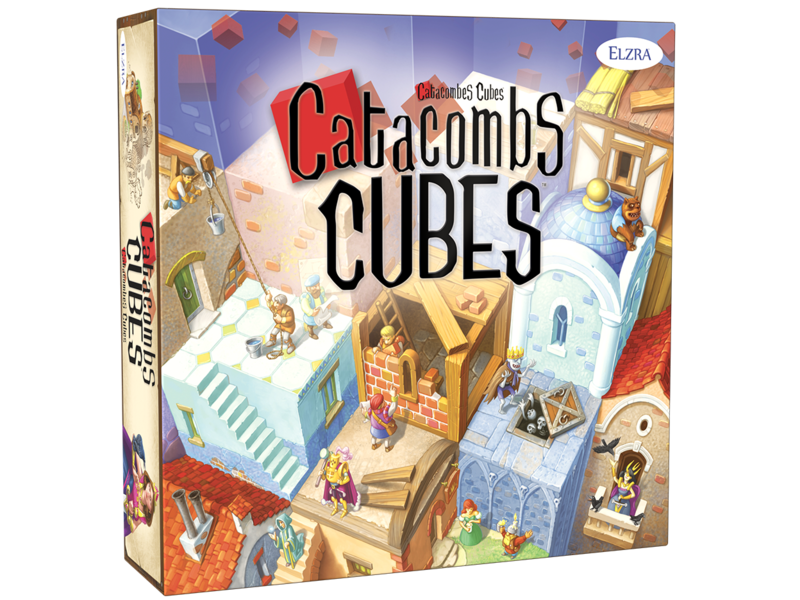
Catacombs Cubes is a city-building game where players compete to earn victory points while constructing the fantasy village of Stormtryne. Players draft wooden resources from the Quarry and use them to physically build structures by stacking uniquely-shaped pieces.
Each player takes on a hero role and constructs buildings on their player board. Completed structures are added to the shared Village Grid, expanding the town from the central Town Hall. The game ends when the Village Grid is complete, and the player with the most victory points wins.
The game combines resource drafting with spatial puzzle-solving. Players must carefully stack their wooden pieces to match blueprint patterns shown on Structure Tiles. Successfully matching the blueprint earns victory points and coins, which can be spent on special actions.
Key Features
Resource Drafting System
Players draft resources from Quarry Offers during their turns. The Quarry Board displays available wooden resource pieces, organised by dice rolls. There are six resource types: Obsidian, Glass, Bamboo, Stone, Clay, and Crystal. Each resource has a unique shape that creates different stacking challenges.
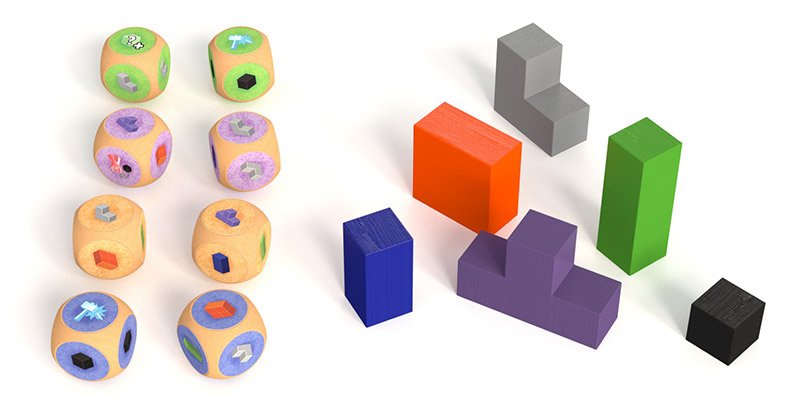
Eight Quarry Dice are rolled each round to determine which resources become available. Players use Quarry Tokens to claim specific resource combinations from the available offers. The dice-driven system creates variability, ensuring no two games offer the same resource availability.
Collected resources go into the Construction Yard on the player board for immediate use, or the Warehouse for storage. Resources in the Construction Yard are returned to the supply after building, while Warehouse resources remain available.
Physical Building Construction
The core gameplay involves physically stacking wooden pieces to match blueprint patterns. Each Structure Tile shows a blueprint indicating the required shape. Players arrange their resources in their Construction Yard, attempting to recreate the blueprint pattern.
The stacking challenge requires spatial reasoning. Some structures use only a few simple pieces, while others demand complex arrangements of multiple resource types. Bamboo pieces are tall and narrow. Stone pieces are blocky. Glass and Crystal pieces create different stacking challenges. Successfully matching the blueprint awards the tile’s printed victory points and coin rewards.
Failed construction attempts cost nothing. Players can try repeatedly until they succeed or choose to pursue a different structure.
Village Grid Expansion
Completed Structure Tiles are placed on the Village Grid, expanding outward from the central Town Hall. The Village Grid grows organically as players add their completed buildings.
Village Tiles come in three levels, with higher levels offering greater rewards but requiring more complex resource arrangements. The Village Plans area displays four available Village Tiles that any player can attempt to build.
When the Village Grid is complete with all Village Tiles placed, the game ends immediately. This creates timing pressure as players race to complete high-value structures before opponents fill the grid.
Shared Palace Construction
All players contribute to building the Palace, a shared project displayed on the Planning Board. Palace Tiles are more challenging than Village Tiles but offer substantial rewards.
Two Palace Tiles are available at the start. The topmost tile is the active Palace. Any player can contribute to Palace construction by building on one of the Palace Foundation squares on the Planning Board.
When a player completes a Palace section, they earn victory points and advance their marker on the Palace Track. The player who contributes most to each Palace receives bonus rewards when that Palace is completed. This creates strategic tension between pursuing personal Village structures and investing in the shared Palace.
Hero Characters and Player Boards
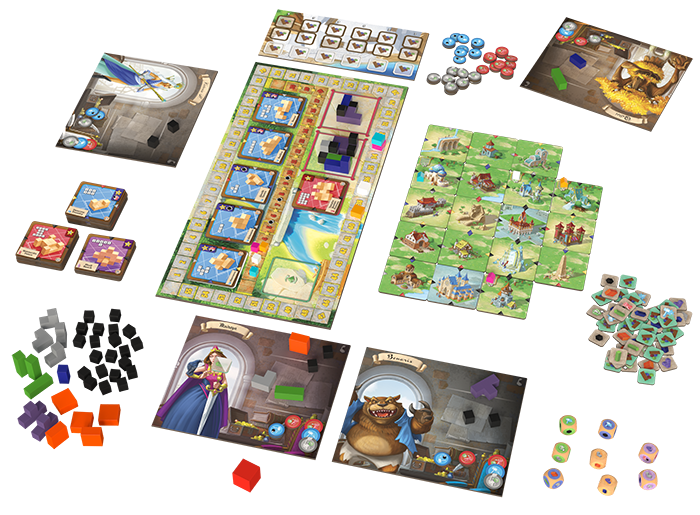
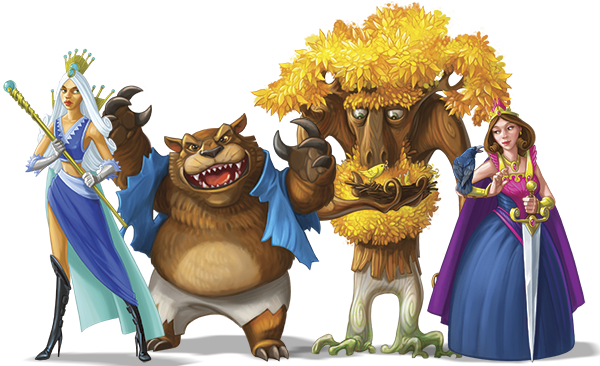
Each player selects a hero character with a unique ability that influences their strategy. Player boards are divided into sections: the Warehouse for stored resources, the Construction Yard for active building, and the Coin Chest for earned currency.
Coins provide flexibility. Players spend coins to take additional actions, reroll Quarry Dice, or access special effects. Managing coin economy becomes crucial for executing complex strategies.
Residence Buildings
Residence Tiles offer a different building opportunity. These personal structures remain on the player board rather than entering the Village Grid. Completed Residences provide ongoing abilities that enhance the player’s effectiveness throughout the game.
Components
Catacombs Cubes includes:
- 4 Player Boards
- 1 Planning Board
- 1 Quarry Board
- 1 Town Hall Tile
- 27 Village Structure Tiles (9 each of Levels 1, 2, and 3)
- 9 Residence Structure Tiles
- 8 Palace Structure Tiles
- 8 Quarry Dice (with stickers to apply)
- 64 Quarry Tokens
- 4 Victory Trackers
- 4 Residence Ownership Trackers
- 4 Palace Trackers
- 1 Quarry Foreman Tracker
- 63 Coins
- 35 Obsidian Quarry Resources
- 6 Glass Quarry Resources
- 6 Bamboo Quarry Resources
- 6 Stone Quarry Resources
- 6 Clay Quarry Resources
- 5 Crystal Quarry Resources
The wooden resource pieces come in distinctive shapes that create different stacking challenges. Obsidian is the most common resource type, used in many structures. Glass, Bamboo, Stone, Clay, and Crystal are specialty resources for advanced buildings.
The game supports 1-4 players in the base game. With the Monuments expansion, it can accommodate up to 6 players.
Awards & Recognition

Resources
Learn to Play
Watch our tutorial video to learn how to play Catacombs Cubes.
Get Your Copy
Purchase Catacombs Cubes from our official stores.